

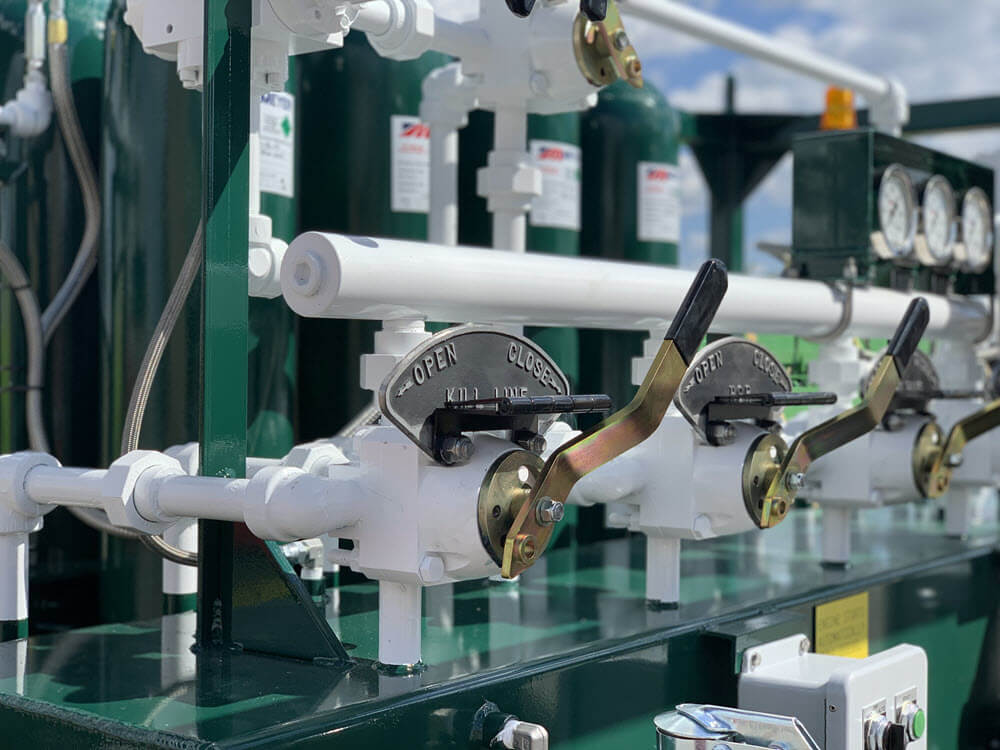
API 16D Explained: The Standard for BOP Control Systems
API Specification 16D is the American Petroleum Institute (API) standard for control systems used to operate drilling well control equipment. It sets minimum design standards for the systems that control blowout preventers (BOPs) and the associated valves that control well pressure during drilling operations, including BOP accumulator units, also called BOP closing units.
For operators, API 16D offers a clear way to confirm that a BOP control system was designed and built to a recognized industry standard. MEYER manufactures and services API 16D equipment from our facility in Corpus Christi, Texas.
What API 16D Covers
Control systems for drilling well control equipment typically use stored energy, in the form of pressurized hydraulic fluid, to open and close the components of the BOP stack. API 16D applies to several categories of these systems:
- Control systems for land-based and surface-mounted BOP stacks
- Discrete hydraulic and electro-hydraulic/multiplex (MUX) control systems for subsea BOP stacks
- Emergency and secondary control systems for subsea BOP stacks
- Control systems for diverter equipment
Within those systems, the specification addresses design requirements for areas such as accumulator pump systems, control valves, fittings, lines, manifolds, and control stations. Diverters are not considered well control devices, but their controls are often built into the BOP control system, so the standard covers them as well.
Current Edition of API 16D
The current edition is API Specification 16D, Third Edition, published in November 2018. API issued Addendum 1 to the third edition in 2023. Always confirm the edition and addenda that apply to your project with API or your equipment provider.
What API 16D Certification Means
For equipment manufacturers, API 16D conformance is managed through the API Monogram Program. Manufacturers licensed under the program can apply the API Monogram to equipment that conforms to the specification, and they must maintain a quality management system that meets API Spec Q1.
MEYER’s Corpus Christi facility holds API Spec 16D license 16D-0046 and API Spec Q1 registration Q1-4531.

API 16D vs. API 16A
API 16D is often confused with API 16A. API 16A covers drill-through equipment, such as the BOPs themselves, while API 16D covers the control systems that operate that equipment. Many well control packages involve both. MEYER’s West Texas Aftermarket facility in Odessa holds API 16A license 16A-0589 and supports BOP and annular aftermarket work.
API 16D Equipment and Service From MEYER in Corpus Christi
MEYER designs and manufactures BOP accumulator units and drilling BOP accumulator units at our Corpus Christi facility. For a closer look at system layout, see our guide to BOP accumulator manifold design.
Keeping equipment in compliance doesn’t stop at delivery. Follow a regular BOP maintenance schedule, use our BOP inspection guide, and plan ahead for the 5-year BOP recertification. MEYER’s service team supports inspection, maintenance, and recertification work, and you can learn more about our Corpus Christi location.
Request a quote or contact MEYER to discuss new API 16D equipment or support for your existing units.
API 16D FAQs
What is API 16D?
API Specification 16D is the American Petroleum Institute standard that sets minimum design standards for systems used to control BOPs and the associated valves that control well pressure during drilling operations.
What equipment does API 16D cover?
It covers control systems for land-based and surface-mounted BOP stacks, subsea BOP stacks, emergency and secondary subsea control systems, and diverter equipment, including the accumulator systems, valves, lines, and manifolds within them.
What is the latest edition of API 16D?
The current edition is the Third Edition, published in November 2018, with Addendum 1 issued in 2023.
What is the difference between API 16A and API 16D?
API 16A covers drill-through equipment, such as BOPs. API 16D covers the control systems used to operate that equipment.
Does MEYER hold an API 16D license?
Yes. MEYER’s Corpus Christi facility holds API Spec 16D license 16D-0046.