

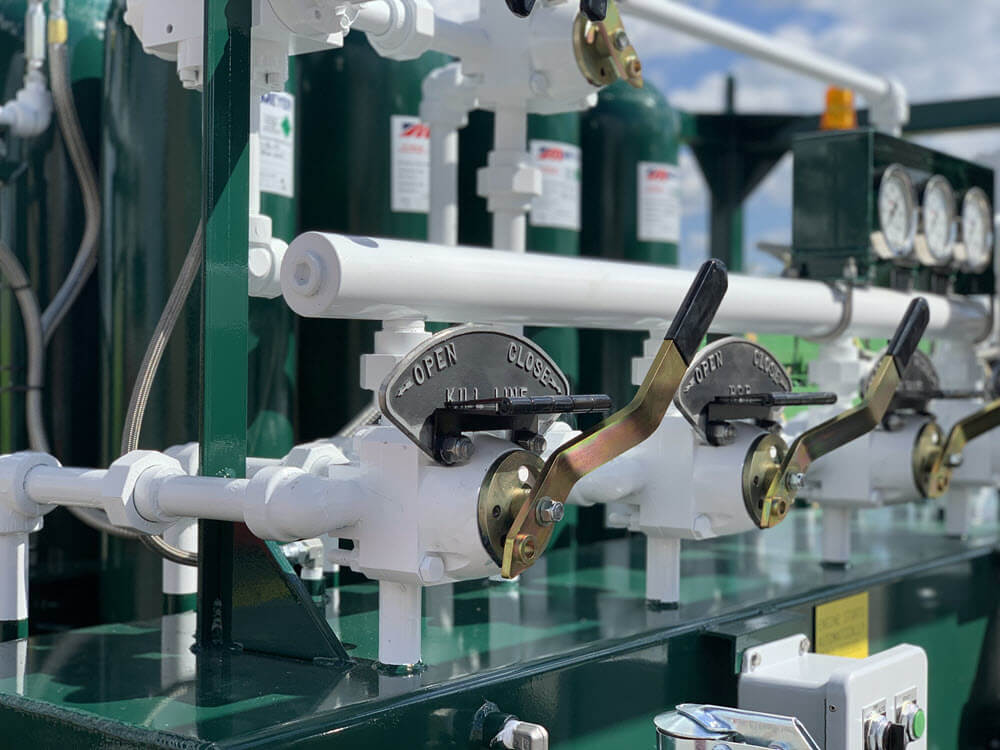
AutoStart Box vs Manual Start BOP Accumulator Units
AutoStart vs Manual Start BOP Units: How to Choose the Right Configuration
Compare AutoStart and manual-start accumulator setups and request the right MEYER build for your drilling program.
MEYER’s AutoStart Box and a manual-start BOP accumulator solve the same core problem in different ways. A manual-start unit depends on an operator to initiate the power path and restore hydraulic readiness, while an AutoStart-equipped unit is designed to respond automatically to pressure changes and restart conditions. In practical field terms, that means manual start can be a good fit where crews are always present and response is tightly supervised, while AutoStart is usually the better choice where remote locations, delayed access, weather exposure, or low-manned operations make immediate operator intervention less predictable. After that first distinction, the real buying decision comes down to restart logic, parasitic power concerns, serviceability, retrofit potential, and how much risk you are willing to accept when pressure drops at the wrong time. Here at MEYER, we build BOP accumulator units to API-16D guidelines, offer AutoStart Box configurations, and support drilling accumulator systems, remote control options, service, rentals, and aftermarket work through our domestic service network. This article explains how each startup strategy works, where each one fits, what we recommend for West Texas and Oklahoma field conditions, and how to decide whether a new build, retrofit, or staged rental unit makes the most sense for your drilling program.
An AutoStart Box is a control component used with a BOP accumulator system to respond automatically to restart conditions tied to pressure behavior. A manual-start BOP accumulator requires direct operator action to initiate startup. For operators working across shale basins and remote drilling sites, the choice affects hydraulic readiness, response time, and operating risk.
Table of Contents
Control Logic and Power Fundamentals
Zero parasitic draw and restart thresholds
Electric, diesel, and air power paths
Serviceability and retrofit factors
Configuration Comparison and Operational Value
AutoStart vs manual start vs hybrid options
Remote drilling and unattended-site use cases
Remote West Texas and Oklahoma deployment factors
Technical Deep Dive: Pressure Restart Bands and Zero Parasitic Draw
Safety Engineering Analysis: Reducing Delayed Response During Pressure Loss
Frequently Asked Questions About AutoStart and Manual Start BOP Units
Control Logic and Power Fundamentals
Key Takeaway: We recommend choosing startup logic based on response certainty, site staffing, and restart conditions, not just on upfront equipment cost.
Zero parasitic draw and restart thresholds
When we compare AutoStart and manual-start accumulators, the most important issue is not the switch itself. It is the control logic behind hydraulic readiness. On a manual-start unit, your crew initiates startup and confirms the system is ready for service. On an AutoStart-equipped unit, the system is designed to auto-respond appropriately to pressure changes, which changes how the unit behaves when pressure falls outside the acceptable operating band. That distinction matters most when the location is remote, crews are spread thin, or site access is not immediate.
We recommend evaluating startup strategy around three technical questions:
- How quickly does the site need the unit to recover hydraulic readiness after pressure loss?
- How likely is it that a qualified operator will be at the unit when restart is needed?
- How much tolerance does the program have for delayed response during a pressure event?
Those questions sound simple, but they separate a good field fit from a weak one. In a staffed environment with direct oversight, manual start can remain a practical and dependable option. In a low-manned or unattended environment, AutoStart can reduce the gap between pressure loss and corrective action because the response does not wait on a person to reach the equipment. That is why our technicians usually frame AutoStart as a readiness decision, not a convenience feature.
The parasitic-draw conversation belongs here too. Operators often ask whether an automated setup means constant unnecessary power consumption. We recommend discussing that directly during configuration because control logic design and power architecture affect how the unit behaves between restart events. The right goal is not automation for its own sake. The goal is automatic readiness without creating avoidable operating burden. When we review startup options with customers, we tie the discussion to the actual field duty cycle, power source, and response expectation instead of assuming every drilling program needs the same logic.
Electric, diesel, and air power paths
Startup choice only makes sense when it is tied to the available power path. Our BOP accumulator units may be configured with explosion-proof or industrial electric motor power, diesel-powered pumps with auto start or manual start availability, and air-motor-powered pump options in single-pump or multiple-pump configurations. That range is important because the best startup strategy on paper can become the wrong strategy if it does not match the site’s actual power reliability and maintenance profile.
We usually guide customers through the power conversation this way. Electric power can be attractive where infrastructure is stable and the installation environment supports that choice. Diesel power is often the stronger fit where mobility, standalone capability, or restart independence matters more. Air-motor packages can be useful where the air system and site requirements support that configuration. The startup method sits on top of that architecture. In other words, AutoStart versus manual start is not a separate decision from the power path. It is part of the same operating logic.
That is also why we do not recommend selecting an AutoStart box only because it sounds more advanced, or selecting manual start only because it looks simpler. If the power path is unstable, the crew is remote, or restart certainty matters more than manual oversight, automation may create better field protection. If the site is consistently attended and the operator wants direct control over restarts, manual start can still be the better answer. Our job is to match the startup method to the operational reality, not force every customer into one configuration.
Serviceability and retrofit factors
Serviceability should be part of the buying decision from the start. MEYER highlights same-day repair or service for BOP closing units and accumulator units, a full inventory of replacement parts, and aftermarket service support for drilling accumulator control units, BOPs, annulars, gate valves, and related pressure-control equipment. That matters because startup logic has to remain maintainable across the life of the unit, not only at commissioning.
We recommend asking three retrofit questions before moving from manual start to AutoStart. First, what is the current unit configuration and how much of the existing control package should remain in place? Second, what power source and panel layout will the upgraded logic depend on? Third, does the operating environment justify the change strongly enough to make the retrofit worthwhile? If those answers are clear, retrofit can be a sound path. If they are not, a new build or hybrid configuration may make more sense.
This is where our broader product line helps. Because we build accumulator units, support remote control systems, service related well-control equipment, and maintain rental availability, we can look at the upgrade decision in context. Sometimes the right move is a retrofit. Sometimes it is a fresh build sized to the drilling program. Sometimes it is a staged rental while the permanent unit is being reconfigured. We recommend deciding after a configuration review, not by assuming the lowest first cost will produce the best long-term operating result.
Configuration Comparison and Operational Value
Key Takeaway: We recommend AutoStart where delayed operator response creates meaningful risk, manual start where direct supervision is constant, and hybrid thinking where duty cycles or staffing patterns change across programs.
AutoStart vs manual start vs hybrid options
The buying decision becomes easier when the startup choices are laid out against the same operational criteria. We build BOP accumulator units with manual-start and auto-start diesel options, and our AutoStart Box page makes clear that the purpose of the system is automatic response to pressure changes. That gives us a clear basis for comparison.
| Factor | AutoStart Box | Manual Start | Hybrid Approach |
|---|---|---|---|
| Restart behavior | Automatic response tied to pressure changes | Operator initiates restart | Manual oversight with automated or staged backup logic |
| Best staffing fit | Low-manned or intermittently attended sites | Constantly attended sites | Mixed staffing environments |
| Response risk during pressure loss | Lower exposure to delayed human response | Higher exposure if operator is not immediately present | Reduced exposure if configured correctly |
| Power-path planning | Must match site power and control logic | Simpler operator-driven sequence | Requires deliberate integration planning |
| Retrofit appeal | Strong when remote readiness is the main driver | Good where simplicity is the priority | Useful when programs vary by location |
| Ideal application | Remote drilling, weather exposure, unattended intervals | Tight operator oversight near the unit | Fleets moving between different site conditions |
| Best For | Operators prioritizing automatic readiness | Crews prioritizing direct manual control | Programs needing flexibility across jobs |
Based on MEYER product specifications.
The difference that matters most is operational consequence. AutoStart is usually the stronger choice when the cost of waiting on a person to restart the unit is higher than the cost of added control logic. Manual start remains a strong option when staffing is consistent, direct control is preferred, and restart response can be guaranteed by procedure. Hybrid thinking works where the same fleet moves between staffed and low-manned environments and the operator wants more flexibility without standardizing every unit to the same configuration. That is the practical verdict we give customers. Choose the startup method that best protects readiness under the actual field conditions, not the one that only looks simplest in the yard.
Remote drilling and unattended-site use cases
This decision becomes clearer when we put it into field use cases. We recommend matching startup logic to a specific operator profile, not to a generic preference.
| Operator Profile | Specific Scenario | Recommended Configuration | Why |
|---|---|---|---|
| Drilling contractor | Remote West Texas location with intermittent staffing | AutoStart | Restart certainty matters more than manual intervention because crews are not always at the unit |
| Operator | Pad with full-time supervision and close equipment access | Manual Start | Direct operator control can be dependable where attendance is continuous |
| Rental company | Fleet moving between attended and low-manned jobs | Hybrid or review-by-job | Configuration flexibility helps avoid overcommitting one logic to all jobs |
| Offshore-adjacent program | Gulf Coast deployment with readiness sensitivity | AutoStart or hybrid | Consequence of delayed response can justify automation |
| Maintenance manager | Existing manual-start fleet under service review | Retrofit review | Upgrade value depends on panel layout, duty cycle, and staffing pattern |
| Multi-basin fleet | Units moving from Oklahoma to Permian to Gulf Coast | Standardized decision matrix | Consistency matters more than ad hoc selection |
Based on MEYER product specifications and service capabilities.
We advise these use cases most often:
- Remote contractor + unattended intervals + diesel package = AutoStart, because automatic response reduces the dependence on immediate manual intervention.
- Staffed drilling site + close operator access + straightforward restart procedure = Manual Start, because direct control can still be efficient and predictable.
- Mixed fleet + changing geography + rotating staffing model = configuration review, because one startup choice may not fit every basin equally well.
This is where commercial value appears. AutoStart is worth more when it reduces exposure to delay. Manual start is worth more when its simplicity matches the site conditions. The wrong choice is usually not the one with fewer parts or more parts. It is the one that ignores how the unit will actually be used.
When customers call us about startup configuration, we usually start with the drilling program, staffing pattern, and power path instead of the accessory list. Our engineering team can review whether the unit should be built around manual start, AutoStart, or a retrofit path tied to the existing package. We also support drilling accumulator systems, remote control system options, and aftermarket service, so we can keep the conversation focused on readiness and maintainability instead of treating startup as an isolated add-on. If you need immediate coverage while we review the permanent configuration, we can also check rental availability for BOP accumulator units and related support equipment through our fleet. To start the review, send us the equipment scope through meyernow.com/request-more-information.html or call 877-44-MEYER and our team will help you size the right path for the job.
Check Rental and Build Options
Regional Field Authority
Key Takeaway: We see the strongest case for AutoStart in regions where distance, weather, and staffing variability increase the chance of delayed manual restart.
Remote West Texas and Oklahoma deployment factors
Our team does not look at startup logic the same way in every region. In West Texas and Oklahoma, crews often balance remote access, long travel intervals, fast-moving schedules, and changing staffing levels across active programs. That makes startup strategy more than a preference issue. It becomes part of how we protect hydraulic readiness when the unit is not always under direct hand-on supervision. MEYER’s Odessa page positions the location around rentals, service, and rapid response for Permian Basin operations, while our broader service network covers Oklahoma City and other drilling centers that support multi-basin activity.
That is why we often recommend AutoStart for remote West Texas work, especially when the unit may sit beyond immediate operator reach. If pressure changes and the unit needs to respond, automatic restart behavior can provide a margin that manual procedures cannot always guarantee under field timing pressure. By contrast, in a consistently attended yard, pad, or drilling setup where operators remain close to the equipment, manual start can still be completely appropriate. The environment drives the recommendation.
The Gulf Coast adds a different layer. Our Corpus Christi and Houston support footprint is tied to offshore-adjacent and inland operations where readiness expectations are high and service support is close at hand. In those environments, startup selection often depends less on pure remoteness and more on how the operator wants to balance direct control, automation, and maintenance planning. Because we support BOP accumulator units, flushing systems, grease manifolds, and hydraulic test equipment from those service bases, we can review startup logic as part of the wider equipment package rather than as a one-off feature decision.
If your next unit is headed to West Texas, Oklahoma, Corpus Christi, or Houston, we can review the deployment environment before you commit to a build or upgrade. Our domestic service network gives us coverage across major operating regions, and our rental fleet gives us room to support short-term needs while a permanent configuration is being finalized. We can also coordinate service, preventive maintenance, and aftermarket support if your current manual-start package needs a retrofit review instead of a replacement. Whether the priority is a new build, a startup-logic change, or coverage during a program transition, we can help align the equipment with the field conditions instead of forcing a generic configuration. Call 877-44-MEYER or send us the program details through meyernow.com/request-more-information.html and we will help you evaluate the best fit.
Technical Deep Dive: Pressure Restart Bands and Zero Parasitic Draw
Key Takeaway: We recommend defining the restart band around real operating needs so the unit restores readiness reliably without creating unnecessary operating burden between events.
The most useful technical conversation in this topic is not “automatic or manual” by itself. It is what pressure behavior should trigger action, how that action should occur, and how often the field program actually exposes the unit to those conditions. Our AutoStart Box product language is brief, but it establishes the essential function clearly: the equipment auto-responds appropriately to pressure changes. That means the practical design discussion centers on the restart band and how the operator wants the unit to behave when the system moves outside the desired condition.
We advise customers to think about the restart band as an operating rule. If the threshold is too conservative for the duty cycle, the unit may behave more actively than the field program wants. If it is too loose, the readiness benefit of automation may be reduced. That is why we recommend reviewing site power reliability, staffing, pressure expectations, and maintenance discipline before finalizing the control logic. The right answer is usually the one that gives the crew confidence the unit will recover as needed without creating unnecessary attention between real restart events.
| Retrofit Review Item | Why We Check It | Decision Impact |
|---|---|---|
| Existing power source | Determines restart path compatibility | Affects AutoStart feasibility |
| Panel layout | Shows what can be retained or modified | Influences retrofit complexity |
| Staffing model | Defines response urgency | Supports AutoStart or manual decision |
| Service history | Reveals maintenance discipline and reliability pattern | Helps justify upgrade timing |
| Site access | Measures delayed-response exposure | Raises or lowers AutoStart value |
| Fleet standardization goal | Keeps units aligned across jobs | Affects whether hybrid logic is practical |
Safety Engineering Analysis: Reducing Delayed Response During Pressure Loss
Key Takeaway: We see the safety value of AutoStart most clearly when it reduces the time gap between a pressure event and the restoration of hydraulic readiness.
OSHA describes BOPs and associated equipment as high-pressure safety valves and related equipment designed to shut off the well hole and prevent a blowout. Federal offshore regulations also require BOP system components and related well-control equipment to be designed, maintained, inspected, tested, and used properly to assure well control in foreseeable conditions, including subfreezing conditions. That context matters because startup logic is not a cosmetic feature. It contributes to how the control system behaves under conditions that can challenge readiness.
From a safety-engineering standpoint, delayed response is the main risk we want to reduce. If the site depends on a person reaching the unit and initiating restart, the real question is whether that intervention can always happen quickly enough under field conditions. Where the answer is uncertain, AutoStart often becomes easier to justify. Where the answer is clearly yes, manual start can remain acceptable and efficient.
We usually assess delayed-response exposure through these factors:
- distance between crew and equipment
- weather or access conditions that slow manual intervention
- staffing gaps during parts of the operating cycle
- consequence of a loss of hydraulic readiness at that location
That is why our recommendation changes from site to site. AutoStart is not automatically safer in every environment. It is safer when the operating context makes delayed manual response a credible exposure. Manual start is not automatically weaker either. It is fully viable where direct oversight is consistent and procedure control is strong. Good engineering judgment is what connects the startup method to the actual safety case.
Key Takeaways
- AutoStart and manual start fit different staffing, access, and restart-risk profiles.
- We recommend AutoStart where delayed operator response could compromise hydraulic readiness.
- Manual start remains a sound option where direct supervision is constant and procedures are tight.
- MEYER builds BOP accumulator units to API-16D guidelines and supports service, retrofit review, and rentals.
- West Texas, Oklahoma, Corpus Christi, and Houston deployments often justify different startup choices.
Frequently Asked Questions About AutoStart and Manual Start BOP Units
When is AutoStart worth it?
We usually recommend AutoStart when the site is remote, intermittently attended, or exposed to conditions that make quick manual restart less certain. The value comes from reducing the time gap between a pressure change and the system response. Our AutoStart Box is designed to auto-respond appropriately to pressure changes, so the stronger the delayed-response exposure, the stronger the case for the upgrade or new-build configuration. That is especially true when the unit supports a drilling program where hydraulic readiness has to be protected without assuming a person will always be standing nearby.
Can it retrofit existing units?
In many cases, yes, but we do not recommend assuming every manual-start package should be converted the same way. We review the power source, panel layout, service history, field duty cycle, and staffing model before we recommend a retrofit path. Because we support drilling accumulator units, remote control systems, aftermarket service, and replacement parts, we can evaluate whether the better answer is a retrofit, a new build, or temporary rental coverage while the permanent configuration is being finalized.
Does it affect maintenance?
It affects how we approach maintenance planning because startup logic is part of the control system, not a separate afterthought. We recommend treating AutoStart-equipped units with the same discipline you would apply to any function-critical control package. That includes periodic service review, restart-logic verification, and confirmation that the power path and related control components are performing as intended. Our service network supports accumulator units, related pressure-control equipment, preventive maintenance, and same-day service response where needed.
Are rentals available with AutoStart?
Rental availability depends on the equipment class, fleet status, and timing of the job. We do offer BOP accumulator rentals and broader oilfield equipment rental support, so when a customer needs short-term coverage while a permanent startup configuration is being reviewed, we can often help identify the right path. The best first step is to send us the job scope, basin, and target dates so we can match the request to available equipment and support.
We build BOP accumulator units for operators who need the startup logic to match the real conditions in the field, not just the spec sheet. From our headquarters in Corpus Christi, TX, we support drilling programs through an API-16D licensed manufacturing and service organization with 11 domestic service locations and a 300+ unit rental fleet that helps customers bridge build, retrofit, and maintenance timelines. If you are deciding between AutoStart and manual start, we recommend reviewing the staffing model, power path, site access, and restart-risk profile before committing to the final configuration. We can help size the unit, review retrofit potential, and coordinate service or rental support around your schedule. To request a quote or configuration review, call 877-44-MEYER or visit https://www.meyernow.com/request-more-information.html .
MEYER
Manufacturing, rentals, service, and aftermarket support for oilfield equipment.
Need help choosing AutoStart, manual start, or a retrofit path?