

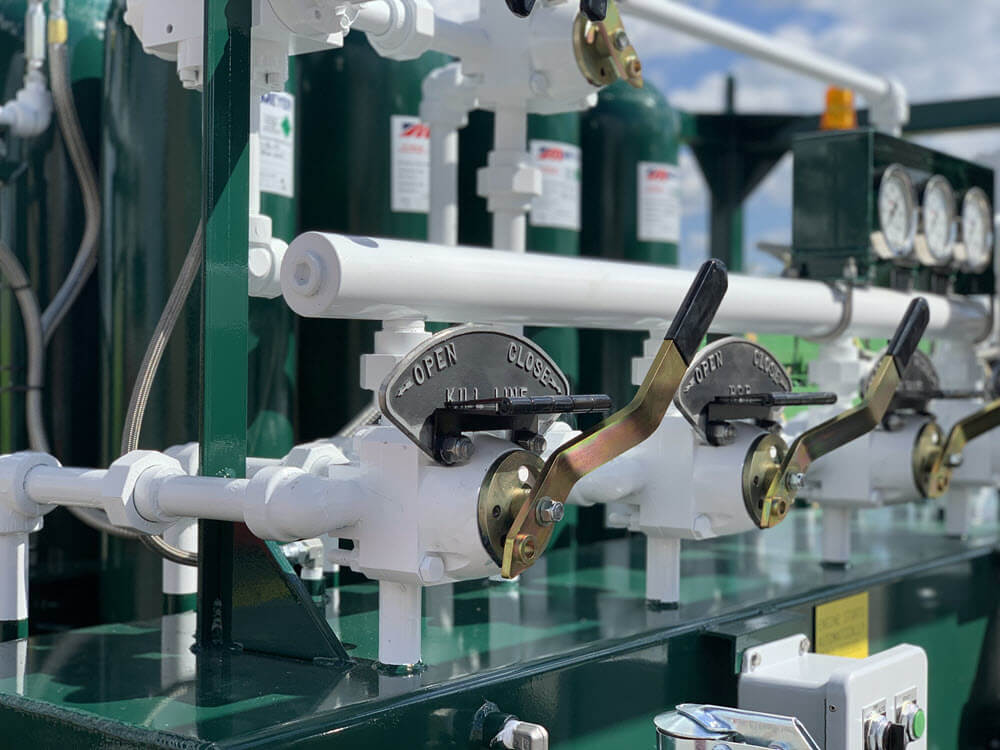
Lubrication Flow Meter Retrofit for Greasing Units
Upgrade greasing units with MEYER lubrication flow meter retrofits for accurate grease measurement in pounds.
Most greasing units in the field still track output by stroke count, not by actual grease delivered. For frac crews, rental companies, maintenance supervisors, and fleet managers running mixed fleets, that gap between strokes and pounds can turn into real uncertainty around usage, cost, and equipment records. This article covers lubrication flow meter retrofit fundamentals, compares measurement options, and explains why pound-based measurement matters more as fleets scale up grease tracking.
MEYER manufactures greasing units and lubrication flow meters, and retrofit measurement is one of the most common upgrade requests we get from customers running non-factory or mixed-brand greasing units. This article focuses specifically on retrofitting existing units with accurate flow meter measurement rather than the general grease-volume topics already covered elsewhere on our site.
Definition: A lubrication flow meter retrofit adds a no-moving-parts flow measurement device to an existing greasing unit or manifold system, replacing stroke-count estimates with a direct, pound-based record of grease delivered.
Table of Contents
Flow Meter Retrofit Fundamentals
12V DC Field and 120V AC Shop Power Options
No-Moving-Parts Durability and Mixed-Fleet Compatibility
Configuration Comparison and Operational Value
Standard Counter vs Lubrication Flow Meter vs SPYDER Integrated Measurement Table
Retrofit Use Cases for Greasing Units and Manifold Systems
Eagle Ford and Permian High-Volume Grease Tracking Needs
Forgotten Specs: Why Stroke Counters Can Create Inaccurate Grease Records
Future Perspective: Retrofit Measurement as the Bridge to Automated Maintenance Records
Frequently Asked Questions About Lubrication Flow Meter Retrofits
Flow Meter Retrofit Fundamentals
Key Takeaway: A retrofit flow meter measures what actually left the unit, not how many times the pump cycled.

Grease Measurement in Pounds
Measuring grease in pounds gives fleet managers and maintenance supervisors a number that ties directly to cost, usage records, and equipment maintenance schedules. A stroke count only tells you how many times a pump cycled, and stroke volume can drift over time as seals wear, temperatures change, or grease consistency varies between products.
A retrofit flow meter sits in the grease line and measures actual flow as it passes through, converting that reading into pounds delivered rather than an estimate based on pump cycles. That distinction matters most once a crew or fleet needs to defend a usage number, whether for cost tracking, warranty support, or maintenance planning.
12V DC Field and 120V AC Shop Power Options
Retrofit flow meters are available in configurations that run on 12V DC power for field units drawing off truck or equipment electrical systems, and 120V AC power for shop-based greasing stations plugged into standard facility power. Matching the power option to where the unit actually operates avoids adding a power conversion step that introduces its own point of failure.
Frac crews and rental companies running units across both field and shop environments should confirm which power option each unit needs before ordering a retrofit kit, since a unit built for shop power will not simply plug into a field truck's electrical system without additional equipment.
No-Moving-Parts Durability and Mixed-Fleet Compatibility
A flow meter with no internal moving parts holds up better in grease service than a mechanical meter with gears or pistons, since grease is thick, sometimes gritty, and hard on components that need to move freely to stay accurate. Fewer moving parts generally means fewer things that can wear, stick, or drift out of calibration over time in continuous field use.
Mixed-fleet compatibility is the other half of the retrofit conversation. Rental companies and maintenance supervisors managing units from multiple manufacturers need a flow meter that can be added to non-factory equipment, not just units built by the same company that makes the meter. We size and fit retrofit kits based on the existing unit's plumbing rather than assuming every unit in a fleet shares the same manufacturer.
When we scope a lubrication flow meter retrofit with a customer, we typically confirm:
- Manufacturer and model of the existing greasing unit or manifold system.
- Field or shop operating environment and available power source.
- Typical grease volume and duty cycle the unit runs in daily use.
- Existing plumbing and fitting sizes to confirm retrofit compatibility.
- Reporting or recordkeeping needs tied to maintenance or cost tracking.
- Fleet size and whether multiple units need standardized retrofit kits.
Configuration Comparison and Operational Value
Key Takeaway: A standard stroke counter, a retrofit flow meter, and a SPYDER integrated system answer the same accountability question with very different levels of accuracy.
Standard Counter vs Lubrication Flow Meter vs SPYDER Integrated Measurement Table
Fleet managers evaluating measurement upgrades often compare three approaches: the stroke counter already built into most standard greasing units, a retrofit lubrication flow meter added to existing equipment, and a SPYDER manifold system with measurement built in from the factory. Each fits a different stage of fleet planning.
| Factor | Standard Stroke Counter | Retrofit Lubrication Flow Meter | SPYDER Integrated Measurement |
|---|---|---|---|
| Measurement Basis | Estimated from pump cycles | Direct flow measurement in pounds | Direct flow measurement, factory integrated |
| Best For | Basic units with no accountability requirement | Existing or mixed-fleet units needing accurate records | New manifold builds where measurement is designed in from the start |
| Fleet Compatibility | Whatever ships on the unit | Fits most existing units regardless of manufacturer | Tied to SPYDER manifold systems |
| Accuracy Drift Risk | Higher, as seals and stroke volume change over time | Lower, with no-moving-parts design | Lower, with no-moving-parts design |
| Ideal Application | Low-stakes, informal usage tracking | Upgrading units already in service across mixed fleets | New manifold installations planning for measurement from day one |
Based on MEYER product specifications.
Retrofit Use Cases for Greasing Units and Manifold Systems
- Frac crew + high-duty-cycle field greasing + 12V DC retrofit: We recommend a field-power retrofit kit sized to the crew's typical daily grease volume so measurement holds up under continuous use.
- Rental company + mixed-brand fleet + standardized retrofit program: We recommend confirming plumbing compatibility unit by unit, then standardizing on one retrofit kit design where fittings allow.
- Maintenance supervisor + cost tracking + pound-based reporting: We recommend replacing stroke-based estimates with retrofit flow meters on units tied directly to cost or warranty reporting.
- Fleet manager + shop-based greasing station + 120V AC retrofit: We recommend a shop-power configuration for fixed stations where facility power is already available and mobility is not a factor.
If your fleet needs to evaluate whether existing greasing units can be upgraded with accurate flow-meter measurement, our team can review your current equipment and recommend the right retrofit configuration. Call 877-44-MEYER or use our request more information form to start a quote.
Regional Field Authority
Key Takeaway: High-volume completions activity tends to push grease tracking from a nice-to-have into an operational requirement.
Eagle Ford and Permian High-Volume Grease Tracking Needs
Frac crews and rental companies working the Eagle Ford and Permian Basin run some of the highest grease volumes in the industry, simply because of how many pumps, seats, and moving components need consistent lubrication across a single completions job. At that volume, the gap between a stroke-count estimate and actual pounds delivered adds up fast, both in cost and in maintenance planning accuracy.
Our Corpus Christi headquarters supports manufacturing and retrofit kit design, while our broader service network helps customers across South Texas and West Texas get retrofit kits fitted to equipment already in the field rather than pulling units out of service for extended periods.
If your crews are tracking grease usage across a high-volume completions program, we recommend using our service locations resource or calling 877-44-MEYER to discuss retrofit lead times for your region.
Discuss Regional Retrofit Needs
Forgotten Specs: Why Stroke Counters Can Create Inaccurate Grease Records
Key Takeaway: A stroke counter measures the pump, not the grease, and the difference between those two numbers grows the longer a unit stays in service.
Stroke counters assume a fixed volume per stroke, but that assumption breaks down as seals wear, as grease consistency changes between products or temperatures, and as a pump ages. A unit that delivered close to its rated volume per stroke when new may deliver noticeably less a year later, while the stroke counter keeps reporting the same estimated output as if nothing changed.
That drift matters most for fleets using stroke counts to plan maintenance intervals, estimate grease costs, or defend usage numbers to a customer or internal finance team. A number that looks precise on a display is not the same as a number that is accurate, and stroke counters are often precise without being accurate once a unit has real field hours on it.
We recommend fleets treat stroke-count output as a rough estimate rather than a record, and reserve pound-based flow meter readings for any number that needs to hold up in a maintenance decision, cost report, or customer conversation.
Future Perspective: Retrofit Measurement as the Bridge to Automated Maintenance Records
Key Takeaway: Accurate grease measurement today sets up cleaner, more automated maintenance tracking tomorrow.
Fleet managers are increasingly expected to show usage and maintenance data that goes beyond a paper log or a rough stroke estimate. A retrofit flow meter that produces a real pound-based number is a practical first step toward that kind of recordkeeping, since it gives the fleet a data point that is actually worth tracking over time.
We expect more fleets to connect grease usage records to broader maintenance planning as equipment ages and as customers, insurers, or internal teams ask for more than a stroke count to justify service intervals or cost allocations. Retrofitting existing units with accurate measurement now means the fleet is not starting that conversation from zero once better recordkeeping becomes standard.
Key Takeaways
- A lubrication flow meter retrofit measures actual grease delivered in pounds, not estimated pump strokes.
- Retrofit kits are available in 12V DC field and 120V AC shop power configurations.
- No-moving-parts meter designs hold up better in grease service and fit most existing mixed-fleet equipment.
- Stroke counters drift in accuracy over time as seals wear and grease consistency changes.
- Pound-based measurement supports more reliable cost tracking, maintenance planning, and future automated recordkeeping.
Frequently Asked Questions About Lubrication Flow Meter Retrofits
Can a lubrication flow meter be retrofitted?
Yes. A lubrication flow meter can typically be retrofitted to an existing greasing unit or manifold system by fitting it into the grease line, provided the unit's plumbing and fittings are compatible. We review the existing equipment first to confirm fit before recommending a specific retrofit kit.
Why measure grease in pounds?
Pounds give a direct, usable number for cost tracking, maintenance planning, and reporting, while stroke counts only estimate output based on assumed pump volume per cycle. That estimate becomes less reliable as equipment ages, which is why pound-based measurement holds up better over the life of a unit.
Does the meter work on non-MEYER units?
Retrofit lubrication flow meters can generally be fitted to non-MEYER greasing units and manifold systems, which is one of the main reasons rental companies and fleet managers request them for mixed-brand fleets. We confirm compatibility based on each unit's existing plumbing before finalizing a retrofit kit.
Are shop and field power options available?
Yes. Retrofit flow meters are available in 12V DC configurations for field units running off truck or equipment power, and 120V AC configurations for shop-based greasing stations connected to standard facility power. We recommend confirming which option matches each unit's actual operating environment before ordering.
Closing
A lubrication flow meter retrofit turns a rough stroke-count estimate into an accurate, pound-based grease record, without requiring a fleet to replace equipment that is already in service. From our headquarters in Corpus Christi, TX, we build greasing units, lubrication flow meters, and retrofit kits for frac crews, rental companies, maintenance supervisors, and fleet managers running mixed equipment across shop and field environments. Call 877-44-MEYER or use our request more information form to evaluate your fleet and request a retrofit quote.
MEYER
Manufacturing, rentals, service, certification, and aftermarket support for oilfield equipment.
Need to evaluate a greasing unit or fleet for accurate flow-meter measurement?
Related Articles
Keep reading more MEYER articles on grease systems, testing equipment, and API certification.
Pressure Testing
Remote Panel Shop Test Units
Compare remote panel hydrostatic shop test unit features and request custom pressure testing equipment from MEYER.
Pressure Testing
Triplex Pump Hydrostatic Test Units
Compare triplex pump hydrostatic test unit specs and request mobile or shop test equipment guidance from MEYER.
Quality Systems
API Spec Q1 for Oilfield Equipment Manufacturers
See what API Spec Q1 means for oilfield equipment manufacturing quality and request MEYER documentation support.
Aftermarket Support
Trust MEYER's Aftermarket Oilfield Services for Longevity and Compliance
See how repair, recertification, inspection, and aftermarket support can help extend oilfield equipment service life.