

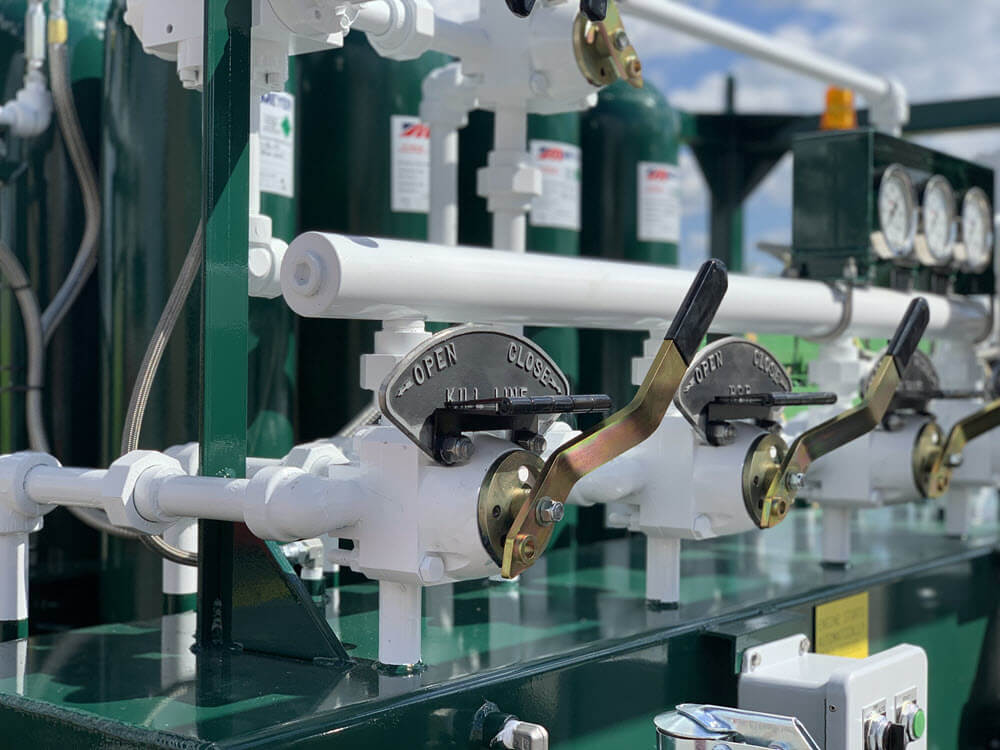
Remote Panel Hydrostatic Shop Test Unit Feature
Compare remote panel hydrostatic shop test unit features and request custom pressure testing equipment from MEYER.
A remote panel hydrostatic shop test unit lets an operator run a pressure test from outside the test booth instead of standing beside the component under test. For pressure control shops, BOP repair facilities, service managers, and rental companies specifying facility testing equipment, the difference between a standard shop test unit and a remote panel configuration usually comes down to operator stand-off distance, remote bleeder control, and how test data is captured and displayed. This article breaks down remote panel testing fundamentals, compares configurations, and outlines the safety and specification details buyers should confirm before requesting a quote.
MEYER builds hydrostatic mobile test units and hydrostatic shop test units for operators, service companies, and rental fleets, and remote panel configurations are one of the most common custom requests we receive from shops testing BOPs, valves, and wellhead components under controlled, repeatable conditions. This article focuses specifically on remote panel operation in shop testing rather than mobile or general hydrostatic testing topics already covered elsewhere on our site.
Definition: A remote panel hydrostatic shop test unit is a stationary pressure testing system operated from a control panel positioned outside the test booth or barricade, allowing the operator to pressurize, monitor, and bleed down a test article without standing next to it during the test.
Table of Contents
Remote Panel Testing Fundamentals
Operator Stand-Off Distance in Shop Testing
Air-Actuated Remote Bleeder Valve Operation
Digital Readouts, Chart Recorder, and Gauge Visibility
Configuration Comparison and Operational Value
Standard Shop Test Unit vs Remote Panel Shop Unit vs Mobile Unit Table
BOP, Valve, and Wellhead Testing Scenarios
Houston, Corpus Christi, and Odessa Facility Testing Demands
Safety Engineering Analysis: Keeping Operators Outside the Test Booth During Pressure Events
Forgotten Specs: Chart Recorder Placement, Gauge Rating, and Bleeder Response
Frequently Asked Questions About Remote Panel Shop Test Units
Remote Panel Testing Fundamentals
Key Takeaway: A remote panel setup moves the operator's hands, eyes, and decision point away from the test article without removing them from the test process.

Operator Stand-Off Distance in Shop Testing
Stand-off distance is the core idea behind a remote panel configuration. Instead of positioning the operator next to the test article while pressure is applied, the control panel is mounted at a distance, behind a barricade, or outside the test booth entirely. That distance is set based on the shop's layout, the pressure ranges being tested, and the facility's own safety procedures. The goal is simple: keep the person controlling the test outside the zone where a fitting failure, hose rupture, or connection issue would put them at risk.
In a shop environment, stand-off distance also changes how the test booth is used day to day. Shops running frequent BOP, valve, or wellhead component tests benefit from a fixed remote station because the operator does not need to re-position, re-enter the booth, or interrupt the test sequence to check a reading. The panel becomes a permanent part of the workflow rather than a temporary safety accommodation.
Air-Actuated Remote Bleeder Valve Operation
The remote bleeder valve is what makes stand-off distance practical. Rather than manually cracking a bleed valve at the test article, the operator triggers an air-actuated bleeder from the remote panel. This lets the operator relieve pressure in a controlled way, at a controlled rate, without approaching the component while it is still under load.
Response time matters here. A bleeder that is slow to actuate or inconsistent in how quickly it relieves pressure makes it harder to control a test sequence and harder to react if a reading looks wrong. Shops specifying a remote panel unit should ask how the bleeder is actuated, how quickly it responds once triggered, and whether the bleed rate is adjustable for different test articles and pressure ranges.
Digital Readouts, Chart Recorder, and Gauge Visibility
Moving the operator away from the test article only works if the operator can still see the test clearly from the panel. That means digital readouts, analog gauges, and any chart recorder need to be sized, lit, and positioned so pressure, hold time, and any drop-off are easy to read at a glance from the operator's stand-off position.
A chart recorder is particularly important for shops that need a documented pressure-versus-time record for a repair, recertification, or customer file. If the recorder is mounted where the operator cannot see it clearly during the test, or where it is easily bumped or obstructed, it undercuts the value of running the test remotely in the first place.
When we scope a remote panel shop test unit with a customer, we typically confirm:
- Test pressure range and test article types the unit needs to support.
- Required stand-off distance based on the shop's booth or barricade layout.
- Bleeder actuation method and expected response time.
- Gauge, digital readout, and chart recorder placement on the panel.
- Documentation needs for repair, recertification, or customer records.
- Facility power, air supply, and space constraints around the panel location.
Configuration Comparison and Operational Value
Key Takeaway: Standard shop units, remote panel shop units, and mobile units solve different problems, and the right choice depends on where testing happens and how much stand-off distance the work requires.
Standard Shop Test Unit vs Remote Panel Shop Unit vs Mobile Unit Table
Shops evaluating facility testing equipment often compare three configurations at once. A standard shop test unit is built for a fixed test booth where the operator works close to the panel and the test article. A remote panel shop unit keeps the booth but separates the operator's controls from the test article. A mobile unit is built to travel to the job rather than stay in one shop location.
| Factor | Standard Shop Test Unit | Remote Panel Shop Unit | Mobile Test Unit |
|---|---|---|---|
| Operator Position | At or near the test article | Outside the booth or barricade | Varies by job-site setup |
| Best For | Lower-pressure or lower-frequency shop testing | Repeated BOP, valve, and wellhead testing at higher pressures | Field and job-site testing away from the shop |
| Bleed-Down Control | Manual, at the test article | Air-actuated, from the remote panel | Configuration-dependent |
| Documentation | Gauge and manual log | Digital readout and chart recorder at the panel | Configuration-dependent |
| Facility Footprint | Fixed, compact booth setup | Fixed booth plus dedicated panel location | Trailer or skid-mounted, moves between locations |
| Ideal Application | Shops with lower test volume or lower-risk components | BOP repair facilities and shops with frequent, higher-pressure tests | Operators and service companies testing in the field |
Based on MEYER product specifications.
BOP, Valve, and Wellhead Testing Scenarios
- BOP repair facility + repeated high-pressure testing + remote panel unit: We recommend a remote panel configuration because it keeps the operator outside the booth across a high volume of repair-and-retest cycles.
- Pressure control shop + mixed valve testing + standard vs remote comparison: We recommend reviewing pressure ranges component by component, since some valve tests may not require the same stand-off distance as BOP testing.
- Service manager + wellhead component recertification + documentation review: We recommend a chart recorder and digital readout combination at the remote panel to support recertification records.
- Rental company + fleet-wide test booth standardization + facility planning: We recommend standardizing remote panel placement across locations so operators trained at one facility can work consistently at another.
If your shop needs to compare remote panel and standard shop test unit configurations before specifying equipment, our engineering team can walk through pressure ranges, test article types, and booth layout to recommend the right setup. Call 877-44-MEYER or use our request more information form to start a quote.
Regional Field Authority
Key Takeaway: Shop testing demand tracks where BOP repair, valve service, and wellhead work actually happens, and Gulf Coast and Permian Basin facilities see some of the highest volume.
Houston, Corpus Christi, and Odessa Facility Testing Demands
Houston-area shops often run a steady mix of valve and wellhead component testing tied to Gulf Coast service and repair work, alongside BOP-related testing that supports both onshore and offshore-adjacent customers. Facilities in this region tend to prioritize throughput, since higher test volume makes a remote panel configuration pay off faster in reduced operator repositioning and more consistent documentation.
Our Corpus Christi headquarters sits at the center of manufacturing, service coordination, and testing equipment support, which means shop test unit specification questions from customers across our service network often route back through Corpus Christi engineering before a build is finalized.
West Odessa and other Permian Basin-area facilities see heavy BOP repair and recertification volume tied to active drilling programs. Shops in this region frequently ask about stand-off distance and bleeder response time specifically because of the pace at which components move through repair and retest cycles.
If your facility is planning a new test booth or upgrading an existing one, we recommend using our service locations resource or calling 877-44-MEYER to discuss regional support and lead times.
Discuss Facility Testing Needs
Safety Engineering Analysis: Keeping Operators Outside the Test Booth During Pressure Events
Key Takeaway: The safety case for a remote panel is straightforward: the fewer people near a pressurized test article, the smaller the consequence if something fails.
A hydrostatic test intentionally pressurizes a component past its normal operating conditions to confirm it holds. That is the point of the test, and it is also the moment of highest risk. A remote panel does not change the physics of the test, but it changes who is exposed if a fitting, hose, or connection fails during that window.
Shops should treat stand-off distance, barricade design, and remote bleeder response as connected decisions rather than separate specifications. A panel positioned too close to the booth undercuts the stand-off distance. A bleeder that is slow to respond extends the amount of time the test article stays pressurized once the operator decides to relieve it. A gauge or chart recorder the operator cannot read clearly increases the chance a problem is missed until it is too late to react calmly.
We recommend shops document their test booth safety procedures alongside the equipment specification, including how the panel location was determined, how the bleeder is tested for response time, and how operators are trained on the remote sequence before running live tests.
Forgotten Specs: Chart Recorder Placement, Gauge Rating, and Bleeder Response
Key Takeaway: The specs buyers skip during a quick quote are usually the ones that matter most once the unit is in daily use.
Buyers comparing remote panel shop test units tend to focus on pump capacity and overall pressure range first, which makes sense since those numbers are easy to compare across quotes. But three details are just as important to daily operation and often get left out of the first round of questions:
- Chart recorder placement: Confirm exactly where the recorder sits on the panel, how visible it is from the operator's normal stand-off position, and how it is protected from being bumped, splashed, or obstructed during a test.
- Gauge rating: Match gauge ranges to the actual pressures being tested rather than defaulting to whatever gauge came standard on a similar unit. A gauge rated far above or below the working range makes fine readings harder to judge accurately.
- Bleeder response: Ask how quickly the remote bleeder actuates once triggered and whether that response time has been tested under the pressure ranges your shop actually runs, not just a generic spec sheet number.
We walk through each of these with customers before finalizing a build because they affect how the unit performs every day, not just how it looks on a spec comparison.
Key Takeaways
- A remote panel shop test unit separates the operator's control point from the test article using stand-off distance.
- Air-actuated remote bleeder valves let operators relieve pressure without approaching the component during the test.
- Digital readouts, gauges, and chart recorders must be visible from the remote position to keep the test controllable.
- Remote panel units suit shops with frequent, higher-pressure BOP, valve, and wellhead testing better than occasional low-pressure checks.
- Chart recorder placement, gauge rating, and bleeder response time deserve the same attention as pump capacity and pressure range.
Frequently Asked Questions About Remote Panel Shop Test Units
What is a remote panel shop test unit?
A remote panel shop test unit is a stationary hydrostatic test system built for a fixed shop test booth, with controls, gauges, and a bleeder valve operated from a panel positioned at a stand-off distance from the test article. It allows the operator to run a pressure test without standing next to the component while it is pressurized.
Why use a remote bleeder valve?
A remote bleeder valve lets the operator relieve test pressure from the panel instead of manually cracking a valve at the test article. That keeps the operator at a safe stand-off distance through the entire test cycle, including the moment pressure is released, which is often when a weak fitting or connection is most likely to show a problem.
What pressure ranges are common for shop testing?
Shop testing pressure ranges vary by component and application, and BOP, valve, and wellhead testing can call for pressures well beyond normal operating conditions to confirm a safety margin. We recommend confirming the exact pressure range for your specific test articles so the pump, gauges, and bleeder on the unit are matched correctly rather than assuming a single range fits every job.
Can MEYER build custom shop test units?
Yes. We build custom hydrostatic shop test units, including remote panel configurations, based on a shop's test booth layout, pressure ranges, test article types, and documentation needs. We can also help compare a remote panel shop unit against a standard shop unit or mobile test unit before you finalize a specification.
Closing
A remote panel hydrostatic shop test unit gives pressure control shops, BOP repair facilities, service managers, and rental companies a way to run repeated, higher-pressure tests while keeping the operator outside the highest-risk zone of the test. From our headquarters in Corpus Christi, TX, we design and build hydrostatic mobile and shop test units, including custom remote panel configurations, to match specific booth layouts, pressure ranges, and documentation requirements. Call 877-44-MEYER or use our request more information form to compare configurations and request a custom quote.
MEYER
Manufacturing, rentals, service, certification, and aftermarket support for oilfield equipment.
Need to compare remote panel, standard shop, or mobile hydrostatic test unit configurations?
Related Articles
Keep reading more MEYER articles on testing equipment, API certification, and pressure control readiness.
API-16D Guidance
API 16D Certification Standards in Corpus Christi
See how API-16D compliance supports accumulator, manifold, and hydraulic control reliability for pressure control operations.
Quality Systems
API Spec Q1 for Oilfield Equipment Manufacturers
See what API Spec Q1 means for oilfield equipment manufacturing quality and request MEYER documentation support.
Aftermarket Support
Trust MEYER's Aftermarket Oilfield Services for Longevity and Compliance
See how repair, recertification, inspection, and aftermarket support can help extend oilfield equipment service life.
Accumulator Systems
BOP Accumulator Systems in Corpus Christi
Review how accumulator systems support hydraulic pressure, BOP response, and well control readiness for Gulf Coast drilling conditions.