

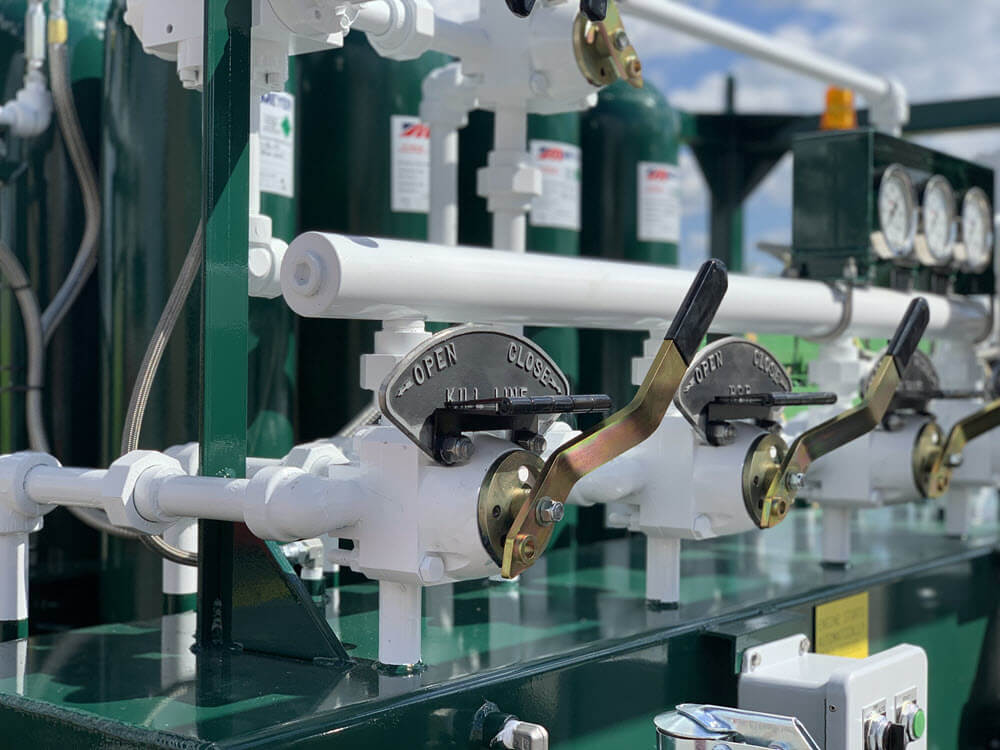
Triplex Pump Hydrostatic Test Units | MEYER
Compare triplex pump hydrostatic test unit specs and request mobile or shop test equipment guidance from MEYER.
The pump on a hydrostatic test unit determines more of the job than most crews expect. Pressure testing crews, service companies, operators, and equipment buyers comparing triplex pump hydrostatic test units usually focus on maximum pressure first, but volume output, horsepower, clutch design, and tank capacity all affect how fast a test article actually fills and holds. This article walks through triplex pump fundamentals, compares pump configurations, and explains why pump selection changes test time more than pressure rating alone.
MEYER builds hydrostatic mobile and shop test units for pressure testing crews, service companies, and rental fleets, and triplex pump selection is one of the most common specification questions we get from customers testing BOPs, valves, wellhead components, and pipe in both shop and field conditions. This article focuses specifically on triplex pump selection rather than general hydrostatic testing topics already covered elsewhere on our site.
Definition: A triplex pump hydrostatic test unit uses a three-piston positive displacement pump to generate high-pressure fluid flow for pressure testing BOPs, valves, wellhead components, and pipe, typically paired with a diesel engine, clutch, and tank sized to the job's volume and pressure requirements.
Table of Contents
Pressure Rating and Volume Output
NOV 15,000 to 20,000 psi Pump Applications
Horsepower, Clutch, and Tank Capacity Considerations
Configuration Comparison and Operational Value
Triplex Pump vs Air-Driven Pump vs Secondary High-Pressure Pump Table
Field Testing, Shop Testing, and Faster Volume-Fill Use Cases
Corpus Christi, Houston, and Offshore-Adjacent Test-Unit Demand
Technical Deep Dive: Balancing Pressure, Volume, and Test Documentation Needs
Field Operations Insight: Why Pump Selection Affects Test Time More Than Crews Expect
Frequently Asked Questions About Triplex Pump Hydrostatic Test Units
Triplex Pump Fundamentals
Key Takeaway: A triplex pump's value comes from the balance between pressure rating and volume output, not from pressure rating alone.

Pressure Rating and Volume Output
A triplex pump uses three pistons working in sequence to produce a continuous, high-pressure flow of test fluid. Buyers comparing units almost always start with pressure rating, since it is the easiest number to line up against a job requirement. But volume output, measured in gallons per minute, is just as important because it determines how quickly a test article fills before pressure can even begin to build.
A pump that hits the required pressure rating but delivers low volume will still get the job done, but it will take longer to fill large-volume test articles like long sections of pipe or larger wellhead assemblies. Crews working against a schedule feel that difference immediately, even when the pressure spec on paper looks identical to a faster unit.
NOV 15,000 to 20,000 psi Pump Applications
Triplex pumps in the 15,000 to 20,000 psi range, including units built around NOV pump platforms, are common on hydrostatic test units built for BOP, wellhead, and high-pressure valve testing. Pumps in this range give crews headroom above typical working pressures so the unit can test components at the safety margins operators require, without pushing the pump itself to its absolute limit on every job.
Matching the pump's rated range to the actual test articles a crew runs matters more than simply choosing the highest-rated pump available. A pump rated well beyond what a crew's typical jobs require adds cost and complexity without adding useful capability, while a pump rated too close to the job's requirements leaves little margin for higher-pressure work that comes up later.
Horsepower, Clutch, and Tank Capacity Considerations
The diesel engine driving the pump needs enough horsepower to maintain volume output at the pump's rated pressure, not just enough to turn the pump over. Underpowered units lose speed as pressure climbs, which slows down exactly the part of the test crews care about most.
The clutch connecting the engine to the pump affects how smoothly the unit engages and how well it protects the pump from shock loading during startup. Tank capacity determines how much test fluid is on hand before a refill is needed, which matters most on field jobs where a water or fluid source is not close by.
When we scope a triplex pump hydrostatic test unit with a customer, we typically confirm:
- Maximum test pressure and typical working pressure for the crew's most common jobs.
- Required volume output based on the size of test articles being filled.
- Engine horsepower needed to hold volume output at rated pressure.
- Clutch type and how the unit handles startup and engagement.
- Tank capacity relative to typical field access to water or test fluid.
- Shop versus field use, since that affects mounting, mobility, and maintenance access.
Configuration Comparison and Operational Value
Key Takeaway: Triplex, air-driven, and secondary high-pressure pumps solve different parts of the same testing problem, and many units combine more than one.
Triplex Pump vs Air-Driven Pump vs Secondary High-Pressure Pump Table
Crews specifying a hydrostatic test unit often compare a primary triplex pump against an air-driven pump or a secondary high-pressure pump used to finish a test after the triplex pump has filled the test article. Each has a different role, and many hydrostatic test units use more than one pump type to balance speed and precision.
| Factor | Triplex Pump | Air-Driven Pump | Secondary High-Pressure Pump |
|---|---|---|---|
| Primary Role | High-volume fill and primary pressure build | Lower-volume pressure build without engine power | Fine pressure adjustment near test pressure |
| Best For | Filling larger test articles quickly | Sites without diesel power or smaller test volumes | Precise hold pressure once the article is filled |
| Volume Output | High | Low to moderate | Low, by design |
| Power Source | Diesel engine | Compressed air | Electric or manual, unit-dependent |
| Ideal Application | BOP, wellhead, and pipe testing with larger fill volumes | Remote or power-limited sites with smaller test articles | Final pressure fine-tuning on any unit |
Based on MEYER product specifications.
Field Testing, Shop Testing, and Faster Volume-Fill Use Cases
- Pressure testing crew + large-volume pipe or wellhead testing + high-output triplex pump: We recommend a triplex pump sized for volume output first, since fill time drives most of the total job time on larger test articles.
- Service company + shop-based BOP testing + fixed triplex pump unit: We recommend confirming shop power and space requirements alongside pressure rating, since a shop-mounted unit can be sized differently than a field-mobile one.
- Operator + remote field job + limited diesel access: We recommend reviewing tank capacity and fuel logistics together with pump output, since a fast pump does little good if fluid or fuel runs out mid-job.
- Equipment buyer + fleet standardization + multiple crews: We recommend standardizing pump specifications across the fleet where possible, so crews can move between units without relearning fill times and pressure behavior.
If your crew needs to compare triplex pump specifications before requesting mobile or shop test equipment, our engineering team can walk through pressure rating, volume output, and job type to recommend the right configuration. Call 877-44-MEYER or use our request more information form to start a quote.
Regional Field Authority
Key Takeaway: Pump selection shifts by region depending on job size, access to power, and how far crews travel between tests.
Corpus Christi, Houston, and Offshore-Adjacent Test-Unit Demand
Our Corpus Christi headquarters supports both manufacturing and direct customer conversations about pump selection, which means most triplex pump specification questions from our service network route through Corpus Christi engineering before a build or rental assignment is finalized.
Houston-area and offshore-adjacent customers often need higher-volume triplex pumps because of the size of wellhead and BOP components tied to Gulf Coast and offshore-support work. Faster fill times matter more when test articles are larger and crews are working against vessel or platform schedules.
Field crews working across West Texas and other inland basins tend to prioritize tank capacity and fuel logistics alongside pump output, since remote well sites are not always close to a water source or fuel supply. If your team is comparing mobile and shop test unit configurations for a specific region, we recommend using our service locations resource or calling 877-44-MEYER to discuss regional support and lead times.
Discuss Regional Testing Needs
Technical Deep Dive: Balancing Pressure, Volume, and Test Documentation Needs
Key Takeaway: The best triplex pump spec balances three things at once: how much pressure the job needs, how much volume the job needs, and how the test gets documented.
Pressure rating and volume output are often treated as separate line items on a spec sheet, but they interact directly with how a test actually runs. A pump with plenty of pressure headroom but limited volume can still struggle on a job that requires filling a large test article quickly, while a high-volume pump with a lower pressure ceiling may not have enough margin for higher-pressure well control components.
Documentation adds a third variable. A gauge, digital readout, or chart recorder needs to keep pace with how quickly the pump builds pressure, especially on high-output units where pressure can climb faster than a slower-reacting recorder can accurately capture. Crews that need a clean pressure-versus-time record for recertification or customer files should confirm the recorder's response time matches the pump's fill and build speed, not just the pump's maximum rating.
We recommend treating pressure rating, volume output, and documentation speed as one specification conversation rather than three separate ones, since a mismatch between any two can slow down a job even when every individual number looks correct on paper.
Field Operations Insight: Why Pump Selection Affects Test Time More Than Crews Expect
Key Takeaway: Fill time, not pressure rating, is usually the biggest driver of how long a hydrostatic test actually takes.
Most crews plan around pressure rating because it is the number written on the job requirement. But once a test article is large enough, the time spent filling it before pressure can even build often outweighs the time spent holding pressure at the target level. A pump with a higher pressure rating but lower volume output can end up slower overall than a pump with a more moderate pressure rating and stronger volume output, depending on the job.
This becomes especially noticeable across a full day of testing multiple components back to back. Small differences in fill time compound quickly, and a crew running a slower-filling pump may finish fewer tests in a shift than a crew running a faster unit with the same pressure capability.
We recommend crews and equipment buyers estimate total job time using both pressure rating and volume output together, rather than assuming the highest-pressure pump available is automatically the most productive choice for their typical workload.
Key Takeaways
- Triplex pumps balance pressure rating and volume output, and both matter for total test time.
- Pumps in the 15,000 to 20,000 psi range give crews margin above typical working pressures for BOP and wellhead testing.
- Engine horsepower, clutch design, and tank capacity affect how consistently a pump performs on the job.
- Air-driven and secondary high-pressure pumps complement a triplex pump rather than replace it on most units.
- Fill time from volume output often affects total job time more than pressure rating alone.
Frequently Asked Questions About Triplex Pump Hydrostatic Test Units
What is a triplex pump used for in hydrostatic testing?
A triplex pump generates the high-volume, high-pressure fluid flow used to fill and pressurize test articles such as BOPs, valves, wellhead components, and pipe during a hydrostatic test. It is typically the primary pump on a hydrostatic test unit, often supported by a secondary pump for fine pressure adjustment near the test target.
What pressure rating do test units need?
Required pressure rating depends on the components being tested and the safety margin required above normal operating pressure. Pumps in the 15,000 to 20,000 psi range are common for BOP, wellhead, and high-pressure valve testing, but we recommend confirming the exact requirement for your specific test articles rather than assuming one range fits every job.
Is a triplex pump better for field testing?
A triplex pump's high volume output generally benefits field testing where crews need to fill larger test articles quickly and move between jobs efficiently. That said, field units also need to account for tank capacity, fuel access, and mobility, so the right configuration depends on the specific field conditions and job size, not the pump type alone.
Does MEYER rent hydrostatic test units?
Yes. We rent and build hydrostatic mobile and shop test units, including triplex pump configurations sized to specific pressure, volume, and job-site requirements. Our team can help compare pump options before you finalize a rental or purchase specification.
Closing
Triplex pump selection shapes how fast a hydrostatic test actually runs, not just what pressure it can reach. From our headquarters in Corpus Christi, TX, we build and rent hydrostatic mobile and shop test units for pressure testing crews, service companies, operators, and equipment buyers, matching pump pressure, volume, horsepower, and tank capacity to the job. Call 877-44-MEYER or use our request more information form to compare pump configurations and request a custom quote.
MEYER
Manufacturing, rentals, service, certification, and aftermarket support for oilfield equipment.
Need to compare triplex pump specs across mobile or shop hydrostatic test units?
Related Articles
Keep reading more MEYER articles on testing equipment, API certification, and pressure control readiness.
Pressure Testing
Remote Panel Shop Test Units
Compare remote panel hydrostatic shop test unit features and request custom pressure testing equipment from MEYER.
API-16D Guidance
API 16D Certification Standards in Corpus Christi
See how API-16D compliance supports accumulator, manifold, and hydraulic control reliability for pressure control operations.
Quality Systems
API Spec Q1 for Oilfield Equipment Manufacturers
See what API Spec Q1 means for oilfield equipment manufacturing quality and request MEYER documentation support.
Accumulator Systems
BOP Accumulator Systems in Corpus Christi
Review how accumulator systems support hydraulic pressure, BOP response, and well control readiness for Gulf Coast drilling conditions.