

Why Data-Logged Valve Preventive Maintenance Matters
Why Data-Logged Valve Preventive Maintenance Matters
See why data-logged valve preventive maintenance matters on frac sites and ask MEYER about SPYDER and flow meter options.
Valve preventive maintenance data logging matters because frac crews need more than a verbal confirmation that a valve was greased. They need records showing grease volume, valve activity, operator action, pressure behavior, alarms, and maintenance timing. MEYER’s SPYDER® Generation 3 grease manifold brings precision and accountability to valve preventive maintenance with optional data logging for job tracking and failure analysis. When paired with lubrication flow meter measurement and remote greasing workflows, documented greasing helps crews reduce guesswork, improve handoffs, support failure analysis, and manage high-volume valve maintenance with stronger operational control.
On busy frac sites, valves may be greased by different crews across multiple stages, shifts, wells, or pads. Without a reliable record, supervisors may only know that a valve was supposed to be greased. That is not the same as knowing how much grease moved, when the activity happened, which station was involved, whether an alarm occurred, or whether the valve showed repeated abnormal behavior. Data-logged maintenance helps move the conversation from memory and paper notes to traceable field information.
This article explains how greasing data logs work, why grease volume matters, how valve-cycle and alarm records can support maintenance decisions, and how SPYDER Gen 3, SPYDER 2.5, remote grease manifolds, and lubrication flow meters help frac crews build better preventive maintenance programs. We also cover configuration options, regional use cases, safety value, failure analysis, and how MEYER can help teams review SPYDER and flow meter options for rental, retrofit, or purchase planning.
Definition: Valve preventive maintenance data logging is the practice of recording greasing activity, grease volume, valve cycles, alarms, pressures, operators, and job timing so frac crews and maintenance supervisors can track valve care, review abnormal conditions, and support better failure analysis across multi-crew oilfield operations.
Table of Contents
Data Logging and Greasing Fundamentals for Frac Sites
Grease Volume Measurement in Pounds
Linking SPYDER Gen 3 with Flow Meters
Manual Records vs Gen 3 Data Logging vs Semi-Automated Tracking
Regional Recordkeeping Demands Across High-Volume Frac Pads
Safety Engineering Analysis: Documented Greasing and Failure Prevention
Future Perspective: Remote Records, Tablets, and Cross-Crew Accountability
Frequently Asked Questions About Greasing Data Logs for Frac Sites
Data Logging and Greasing Fundamentals for Frac Sites
Key Takeaway: Data-logged greasing gives frac crews a clearer record of grease volume, valve behavior, alarms, operator action, and maintenance timing, which supports better preventive maintenance decisions.
Grease Volume Measurement in Pounds
Grease volume is one of the most important data points in valve preventive maintenance because it tells the crew whether the valve received the intended amount of grease or sealant. On a frac site, the difference between “we greased it” and “we measured the grease volume” matters. A verbal note may confirm intent. A volume record gives the maintenance supervisor a better basis for comparison across valves, stages, crews, and shifts.
MEYER’s lubrication flow meters are designed to accurately measure grease volume. They give operators the ability to customize measurement and avoid costly mistakes associated with over-greasing and under-greasing valves. MEYER has also published that its oilfield lubrication flow meter provides quick and accurate readings in pounds, which helps remove the slow and often inaccurate calculations required by standard counters.
The practical value is simple. Under-greasing can leave a valve without enough lubrication or sealant support for the service conditions. Over-greasing can waste material, create unnecessary pressure concerns, and make troubleshooting harder. Measurement does not replace operator judgment, but it gives the crew a more consistent reference point. Over time, those records can show whether one valve needs more attention than the others, whether a crew is applying inconsistent amounts, or whether the valve maintenance program is drifting away from the intended procedure.
For high-cycle frac operations, volume data becomes even more useful because the same valves may be maintained repeatedly over long operating windows. A single grease event may not tell the full story. A pattern of grease volume, timing, pressure behavior, and valve condition can give supervisors a much clearer view.
| Data Point | What It Shows | Why It Matters |
|---|---|---|
| Grease volume | How much grease or sealant was delivered | Helps reduce over-greasing and under-greasing |
| Station number | Which valve or grease point was serviced | Supports multi-valve tracking |
| Time record | When the activity occurred | Improves shift handoff and job review |
| Pressure behavior | How the system responded during greasing | Can flag abnormal restriction or flow conditions |
| Operator action | Who performed or controlled the task | Improves accountability across crews |
| Alarm record | Whether the system flagged an issue | Helps supervisors review abnormal events |
Valve-Cycle and Alarm Records
Valve-cycle and alarm records help turn preventive maintenance from a checklist into a more useful operating history. When a valve is greased repeatedly, the supervisor needs to know whether it behaved normally, whether it required unusual grease volume, whether pressure behavior changed, and whether an alarm or abnormal condition appeared during the job. These records are especially valuable when more than one crew, shift, or service company touches the equipment.
MEYER’s Generation 3 SPYDER® grease manifold includes optional ability to remotely track operations, alarms, grease type, grease usage, pressures, valve cycles, and related activity. That set of records matters because it helps crews separate a one-time greasing issue from a repeated maintenance pattern. If one valve repeatedly requires more grease or shows more alarms than the others, that record can support earlier inspection, better troubleshooting, and a more informed decision before a failure stops the work.
Alarm records also help protect handoffs. A supervisor coming onto a new shift can review whether the prior crew saw normal operation or unusual conditions. That makes the next decision less dependent on memory. It also helps maintenance teams avoid the common problem of chasing a symptom without knowing what happened during prior greasing events.
The goal is not to make every valve maintenance decision automatic. The goal is to give experienced crews better information. Data does not replace field judgment, but it gives that judgment a stronger record to work from.
Linking SPYDER Gen 3 with Flow Meters
SPYDER Gen 3 and lubrication flow meters address different parts of the same maintenance problem. The flow meter helps measure grease volume. SPYDER Gen 3 helps bring precision and accountability to valve preventive maintenance with automated grease programs, remote operation, optional data logging, and the ability to track key job information. Together, they help crews move from manual grease activity to a more structured maintenance program.
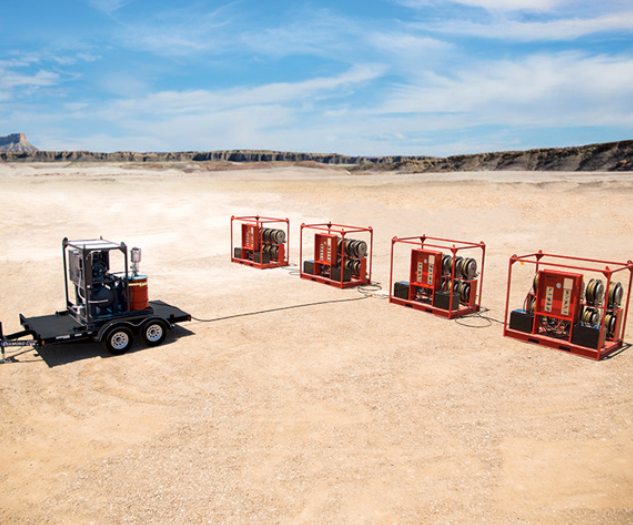
MEYER’s SPYDER Multi-Station Grease Manifold also includes Lubrication Flow Meter support to correctly measure grease volume and integrate customized measurements. The manifold can fit existing greasing units, and modular units can be daisy-chained to support multi-well fracs. That matters for customers who already own greasing equipment but want stronger valve control, better records, or a more scalable frac-site workflow.
SPYDER 2.5 can also be part of the planning conversation because it is a bolt-on addition to the existing Gen 2 Manual Grease Manifold System. It gives customers access to some Gen 3-style features at a more affordable point. For teams not ready to move fully to Gen 3, this can create a practical middle path between manual records and deeper automated tracking.
The best configuration depends on the current equipment, valve count, frac schedule, required data, crew workflow, and budget. We recommend reviewing those factors before choosing between manual flow meter support, SPYDER 2.5, Gen 3 SPYDER, or a rental setup.
Manual Records vs Gen 3 Data Logging vs Semi-Automated Tracking
Key Takeaway: Manual records can work for simple programs, but high-volume frac operations usually benefit from measured grease volume, semi-automated tracking, or Gen 3 data logging.
Greasing Recordkeeping Options Table
Every recordkeeping method has a place. A small or simple operation may use manual logs because the valve count is low and the same crew handles most maintenance. A busier frac site may need lubrication flow meters because grease volume accuracy becomes more important. A multi-crew, high-volume operation may benefit from SPYDER Gen 3 because job tracking, alarm records, remote control, and failure analysis support become more valuable.
| Recordkeeping Method | Best Use Case | Strength | Limitation |
|---|---|---|---|
| Manual grease log | Low valve count or simple maintenance program | Easy to start and familiar to crews | Depends heavily on memory and consistent entry |
| Flow meter tracking | Jobs where grease volume accuracy matters | Measures grease volume more accurately | May still require external record process |
| SPYDER 2.5 semi-automated tracking | Teams upgrading from Gen 2 manual systems | Adds controlled repeatability without full Gen 3 conversion | Not the same as full Gen 3 capability |
| SPYDER Gen 3 data logging | High-volume, multi-crew, or failure-analysis driven programs | Supports job tracking, alarms, grease usage, pressures, and valve cycles | Requires configuration review and crew adoption |
| Remote grease manifold workflow | Difficult access or hazard-zone reduction needs | Allows remote greasing from a safer position | Needs the right station layout and hose plan |
Based on MEYER product specifications and greasing system options.
The comparison verdict is practical. Manual records are acceptable when the maintenance process is simple and easy to verify. Flow meter tracking is stronger when grease volume accuracy matters. SPYDER 2.5 is useful for teams that want some semi-automated control on an existing Gen 2 manual system. SPYDER Gen 3 is the stronger fit when job tracking, failure analysis, alarms, pressures, valve cycles, and remote operation need to be part of the maintenance program.
Frac-Site Risk-Management Use Cases
Data-logged valve preventive maintenance is especially useful when several conditions appear together: many valves, multiple crews, repeated greasing cycles, long operating windows, difficult valve access, pressure-control risk, and frequent handoffs. These are common conditions on high-volume frac sites. In that environment, a paper log may not be enough to support clear accountability.
A multi-crew frac site can use greasing data logs to confirm which valves were serviced, which stations needed more grease, whether abnormal pressure behavior appeared, and whether alarms occurred during the shift. A maintenance supervisor can use that record to compare valves across the pad. An HSE team can use it to review whether remote greasing reduced unnecessary hazard-zone exposure. A service manager can use it to decide whether a valve should be inspected, repaired, or watched more closely.
Data logs also help when there is disagreement after a valve problem. Without records, the discussion may rely on crew memory. With records, the team can review grease activity, timing, volume, alarms, and operating conditions. That does not answer every question by itself, but it makes the investigation more grounded.
If your crew is reviewing SPYDER Gen 3, SPYDER 2.5, lubrication flow meters, or remote grease manifold options, MEYER can help evaluate the current valve maintenance process and the data you need to capture. We can discuss whether existing greasing units can be connected to SPYDER manifolds, whether a bolt-on semi-automated controller makes sense, or whether Gen 3 is the stronger path for job tracking and failure analysis. We can also review rental availability for grease units and SPYDER manifolds if your team needs short-term support before committing to a purchase path. Start through our request more information form or call 877-44-MEYER to compare options with our team.
Regional Recordkeeping Demands Across High-Volume Frac Pads
Key Takeaway: Eagle Ford, Permian, and other high-volume frac regions create strong use cases for grease volume records, cross-crew handoffs, and data-supported valve maintenance.
Eagle Ford and Permian Frac Pad Recordkeeping Demands
High-volume frac regions create more opportunities for recordkeeping problems because the pace of work is faster and the number of valve maintenance events is higher. In the Permian Basin, crews may be working across remote sites with intense schedules, changing weather, and multiple service teams. In the Eagle Ford, high-volume frac work and repeated valve maintenance can make consistent grease volume and handoff records especially important. Across both regions, supervisors need a way to compare activity across valves, crews, and stages.
When a frac pad runs through repeated stages, the valve maintenance record should be strong enough to answer basic questions. Which valves were greased? How much grease was applied? Did pressure behavior change? Did an alarm occur? Which crew handled the work? Did the same valve show a repeated pattern? Those answers can help maintenance and HSE teams review the operation with more confidence.
Regional support also matters because data-logging equipment still has to be deployed, connected, serviced, and supported like any other field system. A SPYDER manifold or flow meter that is available near the basin is easier to stage, service, and rotate than a unit that must move across a long logistics path. That is why frac-site recordkeeping should be planned alongside rental availability, service access, hose routing, and crew training.
| Region or Operation | Recordkeeping Pressure | Useful Data | Recommended Review |
|---|---|---|---|
| Permian Basin | Remote pads and high activity | Grease volume, station, pressure behavior, time | SPYDER and flow meter configuration |
| Eagle Ford | High-volume frac cycles | Grease volume and cross-shift handoff records | Remote grease manifold support |
| Gulf Coast support | Shop, field, and service movement | Service history and repair context | Rental and service coordination |
| Multi-well frac pads | Many valves and repeated events | Station, cycles, alarms, grease usage | Daisy-chain and multi-station planning |
| Multi-crew operations | Shift handoff risk | Operator action, time, and abnormal events | Data logging and supervisor review |
Based on MEYER SPYDER, flow meter, and field support capabilities.
MEYER can support teams that need to review SPYDER manifolds, lubrication flow meters, SPYDER 2.5, Gen 3 SPYDER, or rental options across active oilfield regions. Our Corpus Christi headquarters, West Odessa support, Houston service presence, Kilgore team, and other domestic service locations help crews think through regional availability, field configuration, and service planning. If your operation is trying to improve grease volume records, reduce repeated rig-ups, or strengthen maintenance handoffs, use our service locations resource or contact our team to review the right setup.
Safety Engineering Analysis: Documented Greasing and Failure Prevention
Key Takeaway: Documented greasing helps crews separate lubrication issues from mechanical wear, valve condition, operator variation, and job conditions during failure analysis.
Valve failure analysis is difficult when the maintenance record is incomplete. If a valve fails after several stages, the crew may need to know whether it was under-greased, over-greased, greased at the wrong time, exposed to abnormal pressure behavior, or already showing signs of mechanical wear. Without data, those questions are harder to answer. With records, the team can review grease volume, timing, station history, alarm events, pressure information, and valve-cycle activity.
MEYER’s Gen 3 SPYDER includes optional data logging for job tracking and failure analysis. That is important because failure analysis often depends on sequence. What happened before the problem? Did the same valve show an abnormal record more than once? Did the volume change suddenly? Did an alarm appear before the failure? Did multiple crews interact with the same station? Data logs can help organize those questions.
| Failure Question | Useful Greasing Data | How It Helps |
|---|---|---|
| Was the valve under-greased? | Grease volume and station history | Compares delivered volume against expected process |
| Was the valve over-greased? | Flow meter measurement and pressure behavior | Helps flag excess material or abnormal response |
| Was there a repeated abnormal event? | Alarm and valve-cycle records | Shows whether the problem was isolated or recurring |
| Was the issue tied to a crew handoff? | Time and operator records | Improves review across shifts |
| Was the valve already trending poorly? | Historical station data | Supports earlier inspection or repair decisions |
Documented greasing can also improve safety because it reduces the need for rushed, uncertain decisions near high-pressure equipment. When crews can see what happened, they can make better maintenance decisions and reduce unnecessary repeat work. Remote greasing also supports safer workflows by helping operators grease valves from a more controlled position rather than repeatedly entering higher-risk areas.
Review Lubrication Flow Meters
Future Perspective: Remote Records, Tablets, and Cross-Crew Accountability
Key Takeaway: The next step in frac-site valve maintenance is stronger cross-crew accountability, with remote records, tablet access, and supervisor review built into the greasing workflow.
Frac-site maintenance is moving toward better visibility. Crews still need rugged field equipment, trained operators, and practical procedures, but supervisors also need records they can review without chasing paper logs after the job. MEYER’s Gen 3 SPYDER can be operated by joystick, touchscreen, or tablet and can be controlled from the field, Data Van, or Company Man Trailer. That remote-control model supports a future where greasing records are part of normal frac-site oversight.
Remote records can help crews improve handoffs. A day shift can leave behind a clearer record for the night shift. A maintenance supervisor can compare valves without relying only on verbal reports. A company representative can review whether a job followed the intended maintenance program. An HSE team can look at whether the workflow reduced unnecessary exposure around pressurized equipment.
This does not mean every site needs the same data package. Some teams only need better grease volume measurement. Others need semi-automated control. Others need Gen 3 tracking, alarms, pressure data, valve cycles, and remote operation. The practical path is to match the technology to the risk, valve count, failure history, and reporting need.
The biggest value is accountability without slowing the job. When data collection fits naturally into the greasing workflow, crews can improve maintenance records while still supporting cycle time, safety, and uptime.
Key Takeaways
- Greasing data logs help crews record grease volume, valve activity, timing, alarms, and pressure behavior.
- Lubrication flow meters help reduce mistakes tied to over-greasing and under-greasing valves.
- SPYDER Gen 3 adds precision and accountability to valve preventive maintenance.
- Data records help support failure analysis, shift handoffs, and maintenance supervisor review.
- MEYER can help teams compare flow meters, SPYDER 2.5, Gen 3 SPYDER, remote manifolds, and rental options.
Frequently Asked Questions About Greasing Data Logs for Frac Sites
Why record grease volume?
Crews should record grease volume because the amount of grease or sealant delivered to a valve affects maintenance consistency and later troubleshooting. A record helps supervisors identify over-greasing, under-greasing, abnormal pressure behavior, or repeated problems at a specific station. MEYER’s lubrication flow meters are designed to accurately measure grease volume and help operators avoid costly mistakes tied to incorrect greasing. On multi-crew frac sites, volume records also improve shift handoffs and reduce reliance on memory or handwritten notes.
Can non-MEYER units be retrofitted?
MEYER’s SPYDER Multi-Station Grease Manifold can fit existing greasing units, and modular units can be daisy-chained to support multi-well fracs. The best retrofit path depends on the current grease unit, valve count, hose layout, station requirements, desired data, and whether the customer wants manual flow measurement, semi-automated control, or Gen 3 capability. We recommend reviewing the equipment with MEYER before assuming a retrofit will match the crew’s field needs.
How does this help failure analysis?
Greasing data logs help failure analysis by showing what happened before the problem. A supervisor can review grease volume, station history, valve cycles, alarms, timing, operator activity, and pressure behavior. That record can help separate lubrication issues from mechanical wear, valve condition, crew variation, or job conditions. MEYER’s Gen 3 SPYDER includes optional data logging for job tracking and failure analysis, which supports a more organized review after abnormal valve behavior or equipment downtime.
Are rentals available?
MEYER supports oilfield equipment rentals, including grease units and SPYDER manifolds, through a nationwide rental fleet of more than 300 pieces of equipment. Contact our team to review availability, region, timing, and configuration needs.
Data-logged valve preventive maintenance gives frac crews, maintenance supervisors, and HSE teams a stronger way to manage greasing activity across busy field operations. From our headquarters in Corpus Christi, TX, MEYER supports operators, frac crews, rental companies, and service teams that need better grease volume measurement, remote valve greasing, SPYDER manifold support, and Gen 3 data logging options. We can help compare manual records, lubrication flow meters, SPYDER 2.5, Gen 3 SPYDER, and rental paths based on valve count, crew workflow, risk profile, and maintenance goals. Call 877-44-MEYER or use our request more information form to discuss SPYDER and flow meter options.
MEYER
Manufacturing, rentals, service, and aftermarket support for oilfield equipment.
Need help deciding between lubrication flow meters, SPYDER 2.5, Gen 3 SPYDER, or rental support?